Rest Through the Spirit: Finding Sacred Ground in the Beautiful Chaos of Family Life
A Rest Profile for the Spiritually Oriented Soul — Married with Children
Key Takeaways
Parenthood disrupts spiritual practice, but it can also deepen it.
Children interrupt quiet routines while teaching surrender, presence, sacrifice, wonder, and a more embodied understanding of love.Spiritual rest must adapt to each parenting stage.
In early years it may look like brief moments of attention and simple prayers; as children grow, shared rituals, honest questions, and deeper family conversations become possible.A sustainable spiritual life requires support from the marriage.
Parents need honest conversations, protected contemplative time, and respect for different spiritual needs or beliefs within the household.The parent’s grounded presence is the greatest spiritual gift.
When parents protect their own inner life, they become more patient, present, and able to hold family chaos with meaning and grace.
Children change everything about a spiritual life. They arrive and immediately complicate the quiet, the control, and the interior space that most contemplative practice requires. The meditation cushion becomes a jungle gym. The morning prayer time is interrupted by someone who needs breakfast. The church service, once a refuge, becomes a management exercise. The retreat you were going to attend — the one that was going to restore the part of you that ordinary life can't reach — keeps being deferred because there's no one to manage the children, or the timing is wrong, or by the time you've arranged coverage and packed bags and briefed the other parent, you've spent more energy than the retreat will restore.
And yet. Children also do something to the spiritual life that no retreat, no practice, no tradition can replicate. They make the stakes real. They put love in a form so concrete and helpless and demanding that the philosophical questions — about meaning, about sacrifice, about what life is for — are no longer abstract. Children are relentless spiritual teachers, disguised as sleep-deprived chaos agents. They teach surrender. They teach presence. They teach the irreversibility of love and the terrifying beauty of another person's complete dependence on you.
The spiritually-oriented parent is therefore not a person whose spiritual life has been interrupted by children. They are a person whose spiritual life has been simultaneously disrupted and radically deepened. The challenge is holding both — the disruption and the deepening — without losing either.
The Variable of Children: How Age Shapes Spiritual Rest
Infants and toddlers (0-3): Spiritual rest in this stage is primarily experiential rather than practiced. The exhausted parent with a newborn is not going to maintain a sophisticated contemplative routine. What remains is the quality of attention — the contemplative pause in the feeding, the moment of genuine wonder at the impossibility of this small person, the prayer that is simply "help" — and the recognition that survival itself, in this season, is a form of spiritual labor.
Preschool years (3-6): Children this age are naturally spiritual in ways that can refresh a jaded adult's perception. Their sense of wonder, their lack of ironic distance from the sacred, their willingness to ask the questions most adults have stopped asking — "Where did grandma go?" "Why do people die?" "Does God live in the sky?" — can be profoundly spiritually nourishing for the parent willing to engage them honestly.
Middle childhood (6-12): Children this age are developing their own emerging spiritual identities, asking real questions, and capable of participating in simple shared practices. The family's spiritual life becomes possible in a more structured way. Questions about faith and meaning become explicit, and the spiritually-oriented parent has the opportunity — and responsibility — of honest, age-appropriate engagement.
Teenagers (13-18): The most spiritually complex parenting season. Teenagers often reject the spiritual framework they've been raised in — this is developmentally appropriate and spiritually healthy — and the parent whose own faith is rigid or defensive will struggle. The parent who can hold their own spiritual life with genuine conviction and genuine openness, who can say "this is what I believe and why, and I honor that you may find your own way," is giving their teenager the most valuable spiritual gift available.
The Benefits and Challenges of Spiritual Rest with Different Profiles
When You Share the Same Spiritual Profile
Two spiritually-oriented parents in the same tradition or with compatible practices have something genuinely valuable in the raising of children: a shared framework for the household's meaning-making, ritual life, and engagement with the big questions. The family sabbath is possible. The household prayer or meditation has two committed participants. The children grow up with both parents modeling a life in which the spiritual dimension is treated as real and important.
The challenges: shared spiritual commitment does not mean identical spiritual needs. One parent may need more contemplative solitude while the other is nourished by communal practice. One may be in a season of deep faith while the other is navigating genuine doubt. In a parenting marriage, these individual spiritual movements can be obscured by the demands of managing the family's collective spiritual life — the religious education, the holiday observances, the children's questions — while each parent's interior spiritual journey goes unattended.
What's required: regular spiritual check-ins between spouses, separate from the family's spiritual programming. How is each person doing, spiritually? Not just as parents managing the children's religious formation, but as individuals whose own souls need tending?
When You Have Different Spiritual Profiles
The spiritually-oriented parent married to someone whose rest profile is primarily physical, intellectual, or creative faces the most sensitive negotiation in parenting: what does the family's spiritual life look like when one parent needs it and the other doesn't share the orientation?
This is genuinely common and genuinely navigable. The spiritual parent who needs regular contemplative time, faith community, and shared sacred practice within the family has legitimate needs. The non-spiritual parent who doesn't share these needs but is willing to support them — who facilitates the spiritual parent's practice, who participates in family rituals with respect if not conviction, who engages children's spiritual questions with openness — is providing essential support.
The conversation required is specific and honest: what does the spiritually-oriented parent need, in concrete terms? How much time per week? What practices are non-negotiable? What role, if any, will the children's spiritual formation play, and how are decisions made about it when parents don't share the same framework? These are not easy conversations, but they are far better to have proactively than navigated in crisis.
Spring: Spiritual Renewal and the Family's Sacred Life
Spring's universal spiritual resonance — rebirth, renewal, the return of light — is an invitation for the parenting family to build shared spiritual practice around the season itself, rather than requiring formal religious structure.
Establish a simple family spring ritual. Something brief, repeatable, and genuinely meaningful. A spring walk in which each person names something they're grateful for. A meal prepared from the season's first produce, eaten with spoken gratitude. A seed planted together with the intention of watching it grow — a living metaphor for the kind of patient, faithful attention that spiritual practice requires. Children remember and cherish these rituals; they become the spiritual architecture of family life in ways that formal instruction often cannot.
Protect the spiritually-oriented parent's morning contemplative time. In a family with children, morning contemplative time is one of the first casualties of parenting. Breakfast needs, school preparation, the sheer logistical volume of getting a family out the door — all of it arrives before the spiritually-oriented parent has had their contemplative practice. The solution requires coordination: a pre-agreed morning structure in which the non-contemplative parent handles the children's morning needs on certain days while the spiritually-oriented parent has genuine quiet. This requires explicit negotiation and genuine spousal commitment.
Engage children's spiritual questions with genuine openness. Spring's associations with new life tend to generate children's questions about death, existence, and meaning. Don't deflect these questions to avoid complexity. Engage them with honesty: "I believe X, and here's why. What do you think?" Children who are given genuine engagement with the big questions from an early age develop a spiritual resilience and intellectual seriousness that forms them well for every season of life.
Attend your faith community together as a family, with realistic expectations. Attending religious services with young children is not the contemplative experience it is without them. It is a management exercise with occasional moments of genuine grace. Accept this. Build in the solo contemplative time elsewhere, and let the family attendance be what it actually is: an introduction of children to a community of meaning, a modeling of the practice of showing up, and a social-spiritual experience that is different from but not lesser than the interior contemplative kind.
Summer: Sacred Presence in the Full World
Summer's abundance — its sensory richness, its outdoor orientation, its longer light — offers the spiritually-oriented parent some of the most accessible forms of spiritual rest in the family calendar.
Spend extended time in nature together as a spiritual practice. Children of almost every age respond to natural beauty with a natural reverence that adults have often lost and can rediscover through them. A family camping trip, a week at a lake, a hiking day in a national park — the encounter with the natural world at scale is spiritually nourishing for the parent and genuinely formative for the child. Go slowly. Look carefully. Let the pace be determined by what captures each person's attention.
Establish a summer family sabbath. One day per week — or even one afternoon — that is genuinely free of screens, schedules, and productivity demands. The family sabbath is not about religious observance specifically, though it can be. It is about the countercultural act of stopping together: playing, resting, being together without an agenda. For children, a regular family sabbath provides a rhythm of rest and togetherness that shapes their relationship with both time and leisure for the rest of their lives.
Attend a spiritual retreat if childcare allows. Summer, with its more flexible schedules and the possibility of extended family or camp coverage, is the most structurally accessible season for the spiritually-oriented parent to attend a retreat. Even a single day of directed silence, prayer, or contemplative practice can restore a spiritual reserve that months of parenting depletion have emptied. Make it happen. The parent who returns from a day of genuine spiritual restoration is noticeably different — more patient, more present, more themselves.
Practice presence as a spiritual discipline. Children are masters of the present moment in ways that spiritual practitioners spend years trying to achieve. The parent who brings the attention of their contemplative practice to the activity of playing with their children — genuinely present, not mentally elsewhere, not managing the moment but inhabiting it — discovers something profound: the child's world, entered with full attention, is itself a form of spiritual rest.
Autumn: Gratitude, Loss, and the Family's Spiritual Depth
Autumn's spiritual invitation — toward gratitude, surrender, and the honest acknowledgment of what is ending — is accessible to the entire family, not just its adults.
Create an autumn family gratitude practice. Children thrive with rituals, and a simple autumn gratitude ritual — a jar of notes, a weekly dinner conversation, a gratitude walk — teaches children one of the most important spiritual practices available while providing the spiritually-oriented parent with a form of shared practice that is both genuine and family-integrated.
Acknowledge loss and ending honestly with your children. Autumn's associations with endings are a natural context for honest family conversation about death, change, and impermanence. A grandparent who has died, a friend who has moved away, the school year beginning and the summer ending — these losses, acknowledged with age-appropriate honesty and held within a framework of meaning and continuity, develop children's spiritual resilience in ways that avoidance cannot.
Create a family season of intentional simplicity. Autumn's harvest abundance can easily become autumn's overconsumption in a family context. The spiritually-oriented parent who invites the family into a season of deliberate simplicity — fewer commitments, fewer purchases, more time at home, more attention to what already exists — is practicing a spiritual discipline that the whole family participates in. Children raised in households that occasionally choose simplicity carry a resource for the rest of their lives.
Support each other's individual autumn spiritual practice. Autumn's school rhythms create windows of individual time for both parents. The spiritually-oriented parent who uses these windows for their own contemplative practice needs their spouse's understanding and support. The spouse who holds the household during those hours is participating in the spiritual life of the marriage, even if they don't share its specific content.
Winter: The Dark Season and the Family's Sacred Hearth
Winter is spiritually the richest and most challenging season for the parenting family. Its associations — with the return of light, with the deepest questions of mortality and hope, with gathering together against the cold — are universal and profound. And the cultural context of the winter holiday season makes it simultaneously the most spiritually significant time of year and the most exhausting.
Protect the spiritual meaning of the winter season from its commercial consumption. The holiday season, in its commercial form, is among the most reliably depleting experiences in a parenting family's year. The spiritually-oriented parent who builds a family culture in which the winter season has genuine spiritual meaning — through simple ritual, through the deliberate slowing of the pace, through stories and practices that anchor the season in something larger than gift exchange — is doing some of their most important parenting.
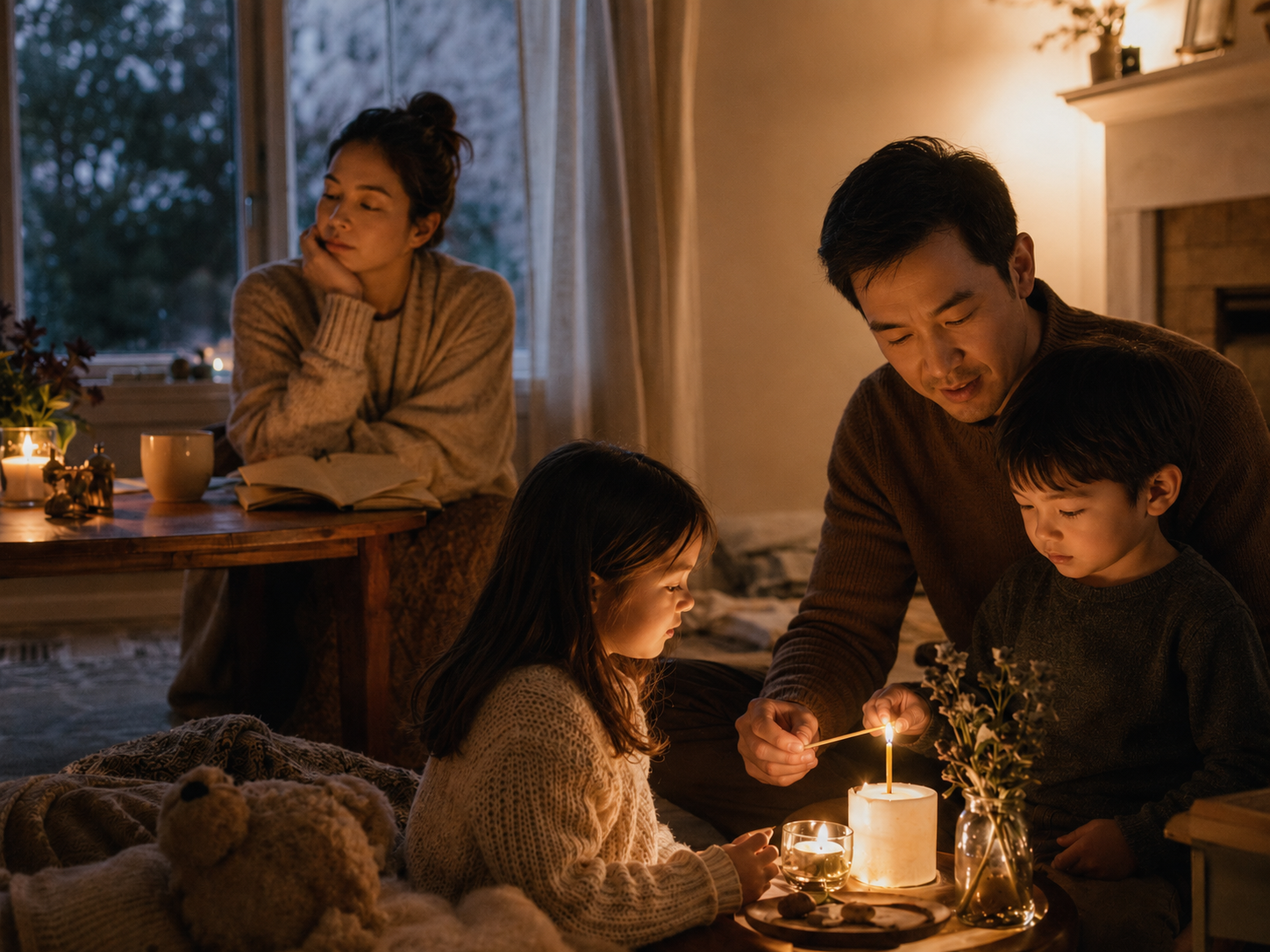
Create winter evening rituals of warmth and presence. Candles lit at dinner. A brief practice of naming one good thing from the day. A story read together before bed. These are simple acts, easily sustained, and they give the winter evening a quality of intentional warmth that is itself a form of shared spiritual rest.
Give each parent genuine spiritual solitude in winter. The school year's rhythm makes this more achievable than it might seem. Both parents need genuine solo time for their own spiritual renewal — and winter's long evenings, combined with school structure during the day, make pre-agreed windows of individual rest more structurally available than any other season. Use them for what restores you most deeply.
Hold the hard questions together as a family. Winter's darkness brings children's questions about fear, about death, about whether the world is safe. The spiritually-oriented parent who can hold these questions — not with false reassurance, but with genuine presence, honest acknowledgment, and a framework of meaning and hope — is giving their children the most important spiritual gift available: the modeling of a faith that does not require certainty in order to provide comfort.
Building Your Spiritual Life as a Parent
The spiritually-oriented parent cannot give their children what they themselves have not received. The contemplative practice deferred indefinitely is not available to strengthen the parent's presence, patience, or capacity to hold difficulty with grace. The spiritual life starved of genuine attention produces a spiritual parent who is going through the motions — managing the family's spiritual programming without being genuinely nourished by it.
Protect your practice. Ask for what you need. Give your spouse space to find what they need. Let your children be your teachers as often as your students.
The spiritual parent who is genuinely fed — whose own inner life is attended to, whose own relationship with the sacred is living rather than merely maintained — is a different kind of presence in the family. More patient. More grounded. More capable of holding the chaos with something approaching grace.
That presence is the most profound spiritual gift you can give your children.
