Rest Through Learning: Keeping Curiosity Alive When You're a Married Parent
A Rest Profile for the Lifelong Learner — Married with Children
Key Takeaways
Parenthood does not erase curiosity—it requires a new structure for it.
Intellectual life may become fragmented, but parents can preserve it through smaller, realistic rhythms instead of abandoning it completely.Learning should adapt to the child’s age and season.
Audio learning, brief reading windows, children’s questions, schoolwork, and conversations with teenagers can all become meaningful sources of intellectual renewal.Intellectual rest must be intentionally protected.
Parents need specific time, supportive household agreements, and learning communities outside the marriage when necessary—not vague hopes of reading more someday.A curious parent helps raise curious children.
When children see adults reading, asking questions, and remaining interested in the world, they learn that growth and discovery continue throughout life.
There is a particular grief that intellectually-oriented parents rarely name out loud: the grief of watching their own curiosity shrink. Not disappear — curiosity this deep doesn't disappear — but contract, fragment, retreat to the margins of a life so organized around other people's developmental needs that there is barely room for their own.
The parent who was genuinely excited by ideas, who used to read three books at once and follow intellectual rabbit holes for entire weekends, who found genuine restoration in the act of learning something new — this parent now manages the logistics of four different people's schedules and reads, if lucky, twenty minutes before exhaustion arrives. They know what they're missing. They feel it as a kind of hunger that doesn't announce itself dramatically but quietly shapes their mood, their presence, and their patience.
This is not self-pity. It is honest acknowledgment of a real cost. And it is the first step toward reclaiming what has been temporarily surrendered.
A lifelong learner with children is not a person who has lost their intellectual life. They are a person whose intellectual life needs a different architecture — one that honors the genuine demands of parenthood while refusing to accept complete intellectual self-abandonment as its inevitable price.
The Variable of Children: How Age Changes the Intellectual Landscape for Parents
Infants and toddlers (0-3): Intellectual rest in this stage must be radically redefined. The reading window has closed to fragments. The sustained thinking has become almost impossible. What remains: audio learning during the physical demands of infant care, the short form of ideas in articles and essays rather than books, and the genuinely novel intellectual territory opened by the experience of early parenthood itself — developmental psychology, infant neuroscience, the philosophy of parental love. The parent who engages these new territories as genuine intellectual interests rather than just parenting management is keeping their intellectual life alive in the only form currently available to it.
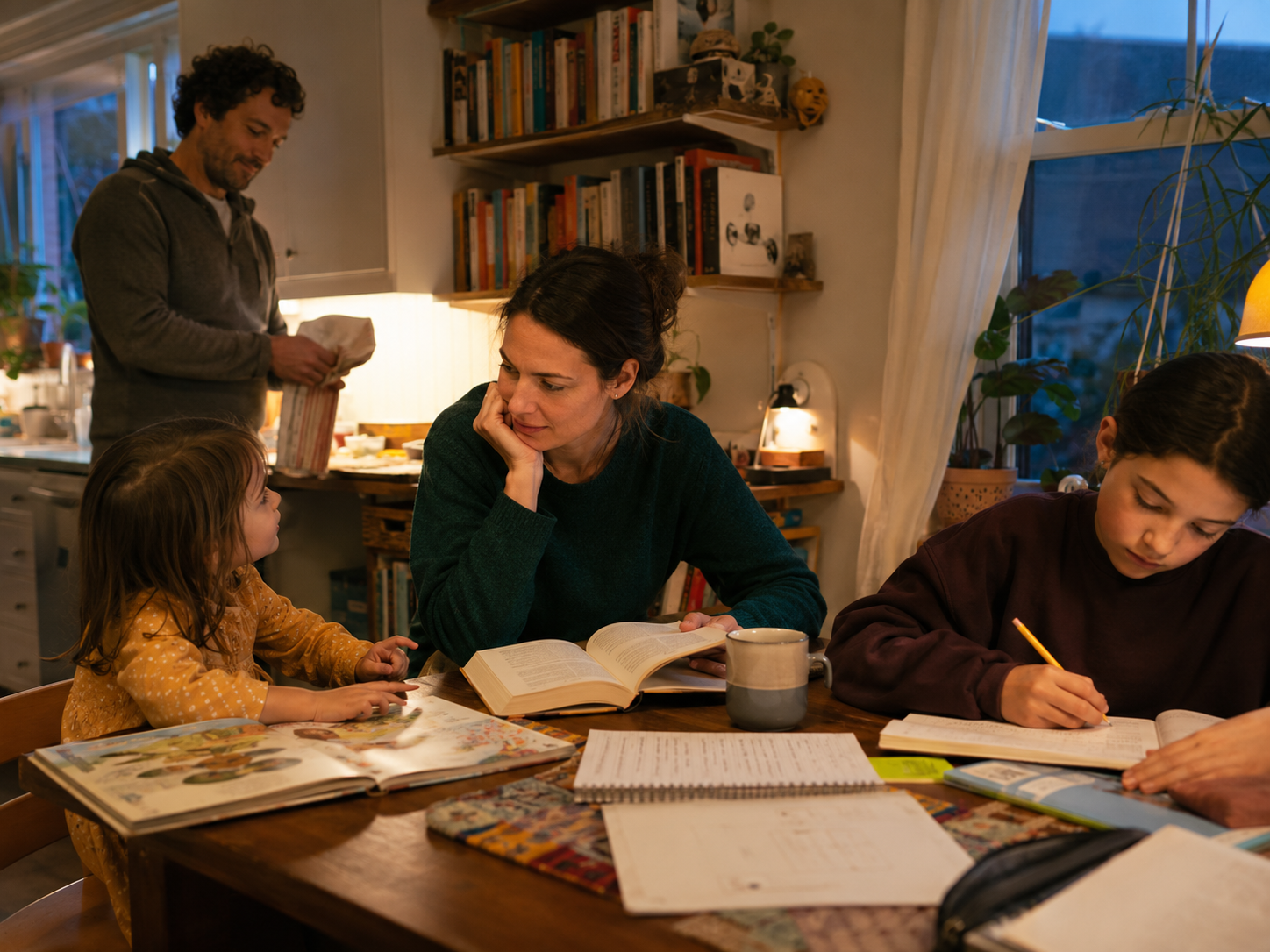
Preschool and early school years (3-8): The intellectual parent begins to reclaim ground. Children's growing independence creates small but real intellectual windows. And children's questions — reliably more philosophically interesting at ages four through seven than at almost any other age — become a genuine intellectual resource. The child who asks "Why do we die?" or "What was there before the universe?" or "Is a dream real?" is offering the intellectually-oriented parent an extraordinary invitation to genuine philosophical engagement.
Middle childhood (8-12): A significantly more sustainable intellectual season. Children's school schedules create predictable windows. Their homework, at this stage, is genuinely intellectually interesting — historical content, literary analysis, scientific concepts — and the parent who engages it with real curiosity rather than management efficiency is finding intellectual stimulation in the middle of their parenting duties. Evening reading becomes more achievable. Intellectual conversations with children become substantive.
Teenagers (13-18): The most intellectually rich parenting season, and the most demanding for the parent whose intellectual authority the teenager is developmentally required to question. The teenager who challenges their parent's views, insists on the complexity of questions the parent thought they'd settled on, and introduces the parent to ideas, music, and perspectives they'd never have found alone — this teenager is one of the most valuable intellectual provocations available to an adult mind. The intellectually-oriented parent who receives this disruption with curiosity rather than defensiveness is being genuinely stretched in exactly the ways intellectual life requires.
The Benefits and Challenges of Educational Rest with Different Profiles
When Your Spouse Shares Your Learning Orientation
Two intellectually-oriented parents navigating a household with children have an extraordinary resource: each other. The dinner conversation that keeps the intellectual life alive, even in five-minute fragments. The book recommendation that makes the next reading window genuinely anticipated. The shared vocabulary of ideas that means even the briefest exchange can carry intellectual depth.
The challenge: two people who both need intellectual rest and are both depleted by the family's demands are in danger of depleting each other's last reserves in intellectual conversation when what they both need more urgently is the restoration of genuine cognitive quiet. The intellectually-oriented parenting couple must be able to distinguish between the conversations that genuinely restore and the ones that are both people processing their depletion in the language they know best.
What's required: the explicit agreement that intellectual rest also includes genuine cognitive rest — the permission to not think hard sometimes, to watch something light together without discussion, to let the mind simply wander. Two intellectual parents who give each other this permission are being genuinely generous.
When Your Spouse Has a Different Rest Profile
The intellectually-oriented parent whose spouse rests through physical activity, creative expression, or spiritual practice faces the specific challenge that parenting magnifies: their intellectual needs must be met largely outside the primary relationship, while the primary relationship demands consistent engagement with the logistical, emotional, and physical demands of family life that leave little cognitive surplus.
The solution is structural, not aspirational: identifying the specific sources of intellectual nourishment that don't require the primary relationship — the book group, the professional community, the intellectual friendship, the online course, the podcast habit — and building these into the family's life as explicitly as any other scheduled activity. The intellectual parent who treats their own intellectual renewal as an infrastructure expense rather than a personal preference is both more likely to protect it and more likely to make its importance legible to a differently-oriented spouse.
The gifts a different-profile spouse brings to the intellectual parent's parenting life are real and worth genuine appreciation. The physically-active spouse who takes the children to the park for two hours on Saturday morning is creating the intellectual parent's most valuable weekly gift: uninterrupted time. The creative spouse who manages the household's beauty and warmth is creating the atmosphere in which thinking happens. Name these gifts. Receive them with genuine gratitude. They are how the different-profile parenting marriage works.
Spring: Intellectual Renewal at the Year's Fresh Start
Spring, with its energy of new beginning, is the ideal season for the intellectually-oriented parent to reassert the intellectual dimension of their life — to begin what has been deferred and to establish the practices that will sustain the learning life through the year's demands.
Define a single focused intellectual interest for the season. Not a reading list of fifteen books. Not a comprehensive curriculum. One focused area of genuine curiosity — a period of history, a field of science, a philosophical tradition, a body of literature — and the intention to follow it wherever it leads across the spring months. Having this focused interest means that the fragmented intellectual windows of parenting life accumulate into something coherent rather than remaining disconnected fragments.
Build an audio learning habit into the physical logistics of parenting. The school run, the grocery shopping, the exercise routine, the household tasks — these are the physical demands of parenting that consume time without requiring cognitive direction. Populating them with substantive audio content — lectures, audiobooks, serious podcasts — converts these periods from intellectual voids into genuine learning time. Across a week, this can add several hours of intellectual engagement to an otherwise intellectually starved schedule.
Have an explicit conversation about intellectual needs with your spouse. Spring is the natural season for this conversation: what does each person need intellectually to be genuinely restored this season, and how does the family's structure support those needs? Not just "I'd like more reading time" but the specific, actionable version: "I need two hours per week of genuine intellectual engagement. Here's what that looks like, and here's what I need from you to make it happen."
Engage children's spring intellectual curiosity with genuine enthusiasm. Spring generates children's questions about the natural world, about growth, about the cycle of things. The intellectually-oriented parent who treats these as genuine invitations — who answers "how do flowers know it's spring?" with actual engagement rather than a quick deflection — is feeding their own intellectual life through the children's questions, finding the wonder in questions they'd stopped asking, and modeling something irreplaceable for their children's own developing intellectual culture.
Summer: Reclaiming Intellectual Ground
Summer offers the intellectually-oriented parent the most accessible season for genuine intellectual recovery — if they approach it with intention rather than allowing it to dissolve into family management and logistical coordination.
Identify and protect two or three genuine intellectual windows per week through summer. A morning at the library while children are at camp. An evening of reading after bedtime. A long weekend afternoon when the other parent takes the children somewhere active. These windows, pre-identified and committed to in advance, convert summer from an intellectual wilderness into a season of genuine, if modest, intellectual progress.
Read for genuine pleasure, without self-improvement agenda. The intellectually-oriented parent in the parenting years often reads with a guilty efficiency — squeezing maximum intellectual content into minimal time, choosing books for their improving qualities, measuring the practice against some imagined standard of intellectual seriousness. Summer is the season to release this and read for genuine pleasure: whatever is most engaging, at whatever pace is enjoyable, without measuring it against anything. Intellectual rest recovered through pleasure is more genuinely restorative than intellectual self-improvement undertaken as duty.
Model intellectual curiosity explicitly for your children. "I've been reading about X and it's so interesting — did you know that Y?" is one of the most powerful parenting acts available to the intellectually-oriented parent. It shows children what it looks like to be an adult who finds the world genuinely interesting. It normalizes learning as a lifelong, pleasurable activity. It invites children into the parent's intellectual world in a way that is both connective and genuinely educational. And it keeps the parent's own curiosity alive in the act of sharing it.
Take one solo intellectual day. A day at a museum, a bookshop, a library, or simply at a café with a book and no responsibility. Arranged with your spouse, protected in the calendar, facilitated by coverage of children. Even one genuinely solo intellectual day per season maintains a quality of intellectual self-connection that parenting's fragmentation consistently erodes.
Autumn: Depth and the Intellectual Parent's Peak Season
Autumn is the intellectually-oriented parent's richest season. The school calendar's return to structure, the cultural atmosphere of seriousness, and the long evenings all support the sustained intellectual engagement that the rest of the year makes difficult.
Begin a significant intellectual project. The course you're taking. The book you're writing. The subject you're studying seriously. The language you're learning. Autumn's school-created windows and its atmosphere of sustained effort make it the season most suited to intellectual projects that require consistency over time. Begin it. Announce it to your spouse. Make it visible in the household's structure so it can be supported rather than crowded out.
Engage your children's school learning as an intellectual resource. The history your twelve-year-old is studying. The novel your fourteen-year-old has been assigned. The science your ten-year-old is encountering. These are genuine intellectual territories, and the parent who engages them with genuine curiosity — reading the same novel, discussing the historical period, looking up the science — is both supporting their child's education and maintaining their own intellectual engagement in one of the most accessible ways available to the parenting season.
Protect the intellectual dimension of your marriage in autumn's busy season. The school year reliably crowds intellectual exchange out of the marriage. Both partners are managing logistics, children's emotional lives, and the household's operational demands. Building in a regular, protected time for genuine conversation — about ideas, about what each person is learning and thinking — maintains the intellectual intimacy of the marriage through the season most likely to erode it.
Attend one intellectually significant event this autumn. A lecture, an author talk, a conference session, a museum exhibition, a significant film with real discussion afterward. Pre-arrange coverage. Put it in the calendar. Go. The intellectual parent who attends one genuinely stimulating public event per season maintains their connection to the wider intellectual world in a way that purely private reading and domestic conversation cannot replicate.
Winter: Slow Learning and the Examined Parenting Life
Winter is the season of reflection — and for the intellectually-oriented parent, it is the season for the examined life: not just intellectual engagement with the external world, but honest, thoughtful engagement with the experience of being the parent they are becoming.
Read deeply and slowly in winter's long evenings. The serious book, taken at leisure, across the winter months. The philosophy that requires re-reading. The novel that opens slowly and pays back patience. Winter's pace and the long post-bedtime evenings are genuinely suited to this kind of reading in a way that no other parenting season is. Claim them. Protect them. Use them.
Engage your children in winter intellectual traditions. Reading aloud as a family — from books of genuine literary quality, chosen by the parent as well as the children. Telling stories at the dinner table. Playing intellectually demanding games. Discussing the news and the world's questions with age-appropriate honesty. These winter traditions build children's intellectual culture while sustaining the parent's own connection to the world of ideas.
Reflect on what you have learned from parenting. The intellectually-oriented parent who treats parenting itself as an intellectual domain — who reads about child development, who reflects on what their children are teaching them about human nature and love and the nature of time, who thinks carefully about what kind of adult each child is becoming and what their own role in that becoming is — is finding genuine intellectual substance in the experience of parenthood rather than experiencing it only as an interruption of their intellectual life.
Name, specifically, what your children have taught you. To your spouse, to your journal, or simply to yourself: what have each of your children taught you this year that you didn't know before? What have they helped you understand about the world, about human beings, about yourself? The parent who can answer this question specifically has maintained the intellectual orientation toward their own experience that defines the lifelong learner — and has found, in the middle of all the parenting chaos, something genuinely worth knowing.
A Final Word for the Intellectual Parent
Your children are watching what it looks like to be a person who loves to learn. The books you read, the questions you ask, the intellectual enthusiasm you bring to the world's complexity — these are among the most important things you will ever model for them.
Protect your intellectual life — not despite your parenting, but in service of it. The curious parent raises curious children. The learning adult produces learning adults.
Keep learning. The world is still endlessly interesting. So are your children. So, if you'll allow it, you all can be.
