Rest Through the Body: How Couples Navigate Physical Recovery When Two Bodies Have Different Needs
A Rest Profile for the Physically Active Soul in a Relationship
Key Themes & Takeaways
Physical rest must account for two different bodies.
Partners may have different sleep schedules, movement needs, pain tolerances, temperatures, and recovery routines. Healthy rest begins with treating those differences as real rather than inconvenient.Shared recovery should not become competition.
Couples can support movement, sleep, nutrition, and recovery together, but comparison and overtraining can quietly turn healthy habits into mutual depletion.The strongest rhythms combine togetherness and individuality.
Walking, stretching, sleep routines, and restorative trips can be shared, while each partner still needs support for their own physical practices and chronotype.Feeling safe and cared for is part of physical rest.
Co-regulation, affectionate touch, protected sleep, and being physically present with one another can help the body feel calm, supported, and able to recover.
Two bodies in one relationship. Different fitness levels, different recovery needs, different pain tolerances, different chronotypes, different relationships with food, different histories with exercise and movement, different capacities for stillness. And both of those bodies needing rest — possibly at different times, possibly in different ways, possibly with a different understanding of what "rest" even means.
The physical rest profile, in the context of a relationship, is one of the most practically complex of all the rest profiles — because unlike spiritual conversation or intellectual exchange, physical rest happens in shared spaces, at shared times, and involves the most intimate territory two people can share: their bodies.
For the person whose wellbeing is closely tied to physical recovery — to good sleep, to movement that restores rather than depletes, to the felt sense of a body that is cared for and well — a relationship introduces variables that solo physical rest management doesn't have to contend with. Someone else's sleep schedule. Someone else's temperature preference. Someone else's relationship with food and exercise that might be radically different from yours. Someone else's body, in the bed, in the kitchen, in the space where you were trying to do your recovery practice.
And yet — for all that complexity — physical rest in a loving relationship also offers something that no amount of solo practice can quite replicate: being held. Being accompanied in your physical vulnerability. Having your body witnessed by someone who loves it. The research on co-regulation — the way two nervous systems in proximity genuinely influence each other — suggests that this is not sentimental. It is physiologically real.
The Benefits and Challenges of Physical Rest Together
When You Share the Same Physical Rest Profile
Partners who share a physical orientation to rest — who both understand the importance of movement, recovery, sleep quality, and physical self-care — have a natural alliance that makes building restorative physical habits dramatically easier. You can motivate each other on the days when motivation is low. You understand each other's rest days without interpreting them as laziness. You can design a shared home environment — sleep temperature, meal rhythms, active recovery practices — around mutual physical needs without extensive negotiation.
The challenges tend to emerge around performance and comparison. Two physically active partners can develop an unhealthy competitive dynamic — each pushing the other toward greater intensity when what both need is more recovery. Partners who both value physical fitness can also collude in a culture of overtraining that looks supportive but is actually enabling mutual depletion.
The practices that help: explicitly distinguishing active training days from recovery days, and supporting each other equally in both; avoiding comparison of each other's physical capacity, which changes constantly with age, stress, and life circumstance; and making physical recovery — not just physical activity — a shared priority.
When You Have Different Physical Rest Profiles
This is more common: one partner whose wellbeing is tightly tied to physical recovery and one whose rest profile is primarily mental, creative, or spiritual. The physically-oriented partner wants to walk on Sunday mornings, needs a cool, dark room to sleep well, is particular about meal timing and food quality, and has a recovery routine that takes real time. The differently-oriented partner might find all of this detail exhausting to navigate or might not understand why a missed workout affects mood so significantly.
The benefits of navigating this difference with care are real. The physically-oriented partner often helps the more sedentary one get outside, move more, sleep better — making real improvements in a partner's health that the partner might not have sought alone. The differently-oriented partner can help the physical person ease the perfectionism that often accompanies high physical self-awareness — modeling that rest doesn't require a recovery protocol to be valid.
The key is honest communication about what physical needs actually are, without either pathologizing the partner who doesn't share them or abandoning one's own needs to keep the peace.
Spring: Waking the Shared Body and Building Joint Physical Rhythms
Spring's invitation to physical reawakening is one of the most natural shared couple experiences available. The longer days, the warming air, the instinct to be outside and moving — these are virtually universal, and spring is the ideal season for couples to establish shared physical rest practices.
Begin a daily walking ritual together. Not as training. Not with fitness trackers or pace goals. A walk taken together each morning or evening as a deliberate act of joint physical rest — slow enough to talk, or slow enough to be companionably silent, or some of both. Research on walking and wellbeing is among the most robust in health science. Walking together also produces a particular quality of conversation — parallel rather than face-to-face — that couples often find easier for difficult or important subjects. Spring makes this practice easy to begin and pleasant to maintain.
Design a shared sleep environment upgrade. Spring is the ideal time to audit and improve the conditions in which you sleep together. Temperature (most sleep research identifies slightly cool as optimal — around 65-68°F — and partners who disagree on this can experiment with separate covers), darkness (blackout curtains benefit both partners), noise management (white noise machines, earplugs kept accessible), and light management at waking (a sunrise alarm clock synchronized for the earlier riser). These are not individual preferences to be negotiated but shared physical investments.
Establish your individual physical recovery practices and communicate them clearly. For the physically-oriented partner, spring is the time to articulate clearly — without apology and without requiring agreement — what physical recovery actually requires. A stretch routine in the morning. A weekly yoga class that isn't available for social scheduling. A nutrition approach that isn't flexible around convenience. These needs are real, and a partner who understands them specifically can support them specifically.
Find your overlapping physical pleasures. What movement do you both actually enjoy? Not what one drags the other to — but genuine, mutual pleasure in physical activity. For some couples it's hiking. For others it's dancing, cycling, swimming, tennis, gardening, or recreational sport. These overlapping physical pleasures are worth investing in, because they provide both physical restoration and relational connection simultaneously.
Summer: Embodied Joy and the Physical Season of Togetherness
Summer is the physical rest profile's natural season. Warmth, water, outdoor movement, longer days, and the cultural permission to slow down and enjoy physical existence — summer is made for the body.
Spend extended time in or near water together. Swimming, paddling, floating, sitting by water — these activities combine physical restoration with the parasympathetic calming that water proximity consistently produces. The autonomic nervous system responds to water in measurable ways, and for couples who need joint decompression, time at water is one of the most effective interventions available. Plan it deliberately and protect it from the social demands that tend to crowd summer schedules.
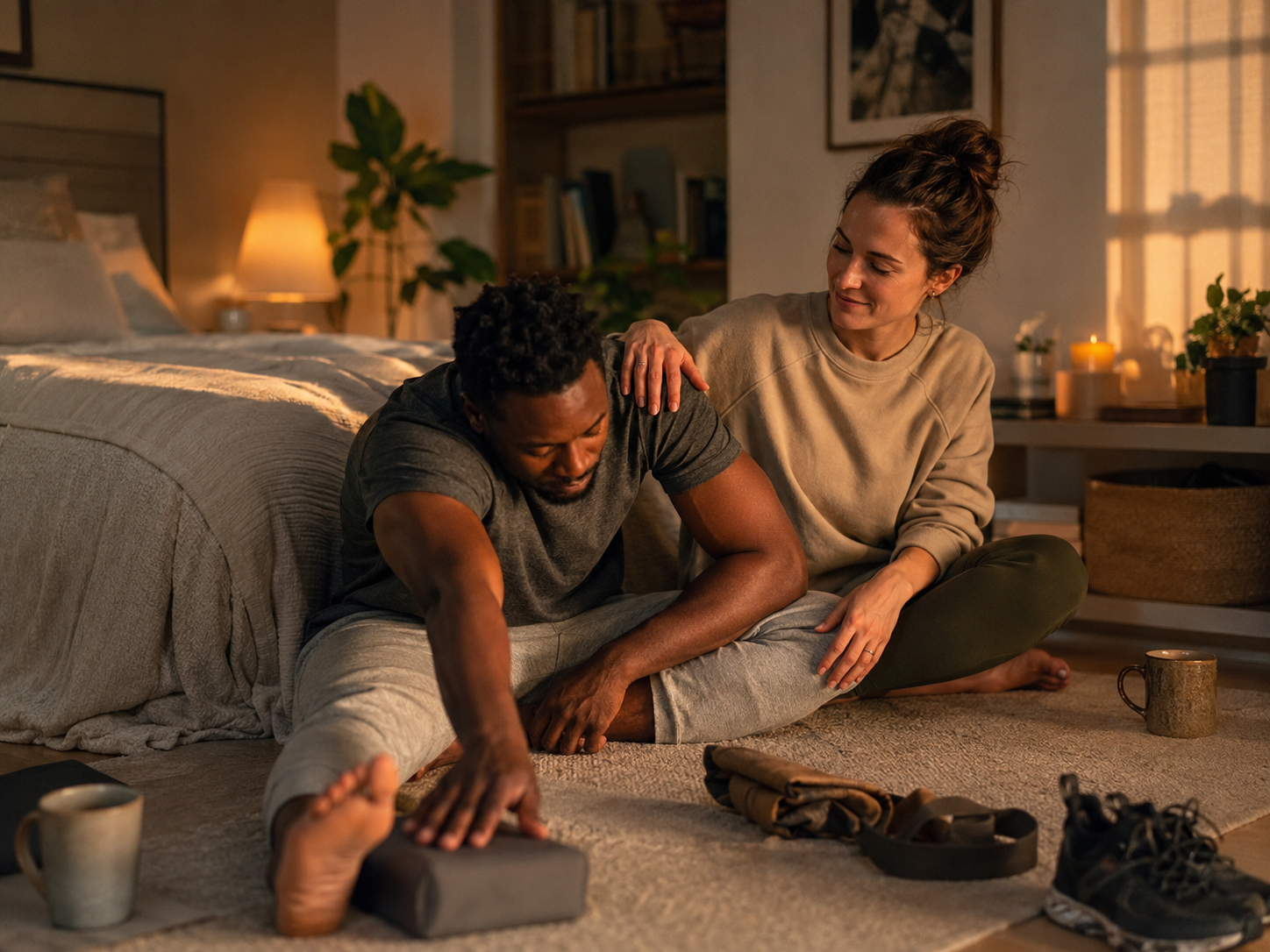
Create a shared recovery ritual for the end of the day. A walk after dinner. A short yoga sequence done together at whatever skill level. A stretching routine while talking about the day. Physical rituals that mark the transition from activity to rest are one of the most evidence-backed practices in sleep and recovery science. Done together, they also function as a relational ritual — a daily moment of shared physical presence that grounds the relationship in the body rather than just the mind.
Plan a physically restorative summer trip. Not a trip packed with activity and sightseeing — a genuinely restorative one. A cabin with good hiking and early bedtimes. A beach week with no agenda. A yoga retreat. A slow exploration of a single region on foot. The difference between a holiday that depletes and one that restores is often simply the density of activities and the quality of the sleep. As a couple, making this explicit — choosing rest over itinerary — is an act of mutual care.
Support each other's solo physical practices. Summer's social abundance can pressure both partners to abandon individual physical routines for shared social commitments. The partner who runs every morning needs their partner's active support for that practice — not just tolerance of it. "I'll manage the morning so you can run" is a sentence that is worth saying, regularly, through the whole summer.
Autumn: Recovery, Body Listening, and the Physical Harvest
Autumn asks the body — and the relationship — to slow down from summer's activity and begin the transition toward genuine recovery. It is the season to audit what summer's physical demands have produced and begin intentionally restoring what was expended.
Take the recovery seriously. If summer involves training, travel, physical work, or any other sustained physical demand, autumn is the season for deload — a deliberate reduction in physical intensity, with increased emphasis on sleep, nutrition, mobility, and rest. In a relationship, doing this together — both partners explicitly choosing a lower-intensity physical season — normalizes recovery as a legitimate phase rather than a failure of discipline.
Invest in professional physical care. Massage, chiropractic, physiotherapy, acupuncture — whatever form of professional bodywork resonates. Autumn is the ideal season to schedule these, both individually and (where appropriate) together. A couples' massage is not a luxury indulgence — it is a genuinely effective physiological intervention for partners who are both carrying high physical stress loads.
Nourish the body with seasonal intention. Autumn's harvest offers some of nature's most nutrient-dense food — root vegetables, squash, apples, dark greens, warming spices, proteins that support recovery. Cooking together with genuine care — a Sunday soup, a slow-roasted dinner, a pantry built around the season — is an act of shared physical self-care that also engages the sensory and relational. Eating well together is one of the simplest and most consistent predictors of relationship satisfaction in long-term partnership research.
Develop a joint evening wind-down routine. As the season darkens and the days shorten, the body's natural inclination is toward earlier evenings. Working with this — dimming lights after sunset, reducing screen exposure, building a consistent bedtime routine as a couple — produces measurably better sleep for both partners. The specific components matter less than the consistency and the shared commitment.
Winter: Deep Rest, Physical Vulnerability, and Being Held
Winter is the body's season of genuine recovery — and in a relationship, it is the season for the most intimate form of physical rest: being in the same warm space as someone who loves you, without having to perform, achieve, or manage yourself.
Allow genuine, purposeless physical rest. A Sunday in bed until noon. A week of earlier bedtimes. An afternoon on the couch that leads nowhere. For the physically-oriented partner, this kind of "unproductive" physical rest can trigger guilt — the sense that time not spent in movement or formal recovery is time wasted. In a relationship, the partner who models or encourages purposeless rest is offering a genuine gift.
Practice co-regulation deliberately. Co-regulation — the phenomenon whereby two nervous systems in close proximity influence each other toward either greater activation or greater calm — is one of the most powerful and underused tools available to couples managing stress and burnout. Slow, synchronized breathing. Physical contact that is not sexual — a hand on the shoulder, a foot touching a foot, sitting in genuine proximity. Extended, unhurried hugging (research by Dr. Paul Zak suggests that a twenty-second hug produces significant oxytocin, which reduces cortisol and strengthens immune function). In winter especially, the body needs these inputs, and a loving relationship provides them.
Attend to the physical changes that winter brings. Seasonal Affective Disorder affects a significant portion of the population and manifests in the body as well as the mind — increased fatigue, changed appetite, disrupted sleep architecture, reduced physical motivation. Partners who understand this in each other — and who support the interventions that help (morning light exposure, regular outdoor activity even in cold, consistent sleep schedules, professional support when needed) — provide a form of physical care that is genuinely protective.
Sleep generously. Give each other permission to sleep as much as the body asks for in winter. This is not a modest ask in a culture that treats sleep as a productivity variable to be minimized. But it is one of the most significant physical gifts partners can give each other: the protection of each other's sleep, in every dimension — noise, light, schedule, and the implicit social permission to rest rather than perform alertness.
Building Your Physical Rest Practice as a Couple
Talk about your physical needs without apology. The physically-oriented person in a relationship often soft-pedals their recovery requirements to avoid seeming high-maintenance. Don't. Your body's needs are real, communicating them clearly is kind to both of you, and a partner who understands them can support them.
Honor each other's chronotypes. One partner's need for early sleep and early rising is not a preference to be negotiated away. Neither is the other. Find the genuine overlaps and protect the individual rhythms that don't overlap.
Make physical touch a daily priority. Nonsexual physical contact — affectionate, intentional, unhurried — is one of the most powerful physiological regulators available to couples. Don't let the busyness of shared life crowd it out.
A Final Word
Two bodies in one life. Different rhythms, different needs, different histories. And underneath all that difference, the same fundamental need: to be held, to be rested, to feel safe in the body that carries you through the world.
A relationship offers the extraordinary gift of another person who can be part of your physical recovery — not just by staying out of the way, but by actively contributing to the conditions in which you heal.
Rest into that. Let yourself be held.
That, too, is a form of physical rest that nothing else can replicate.
