Rest Through Learning: Building an Intellectual Marriage Without Children
A Rest Profile for the Lifelong Learner — Married, No Children
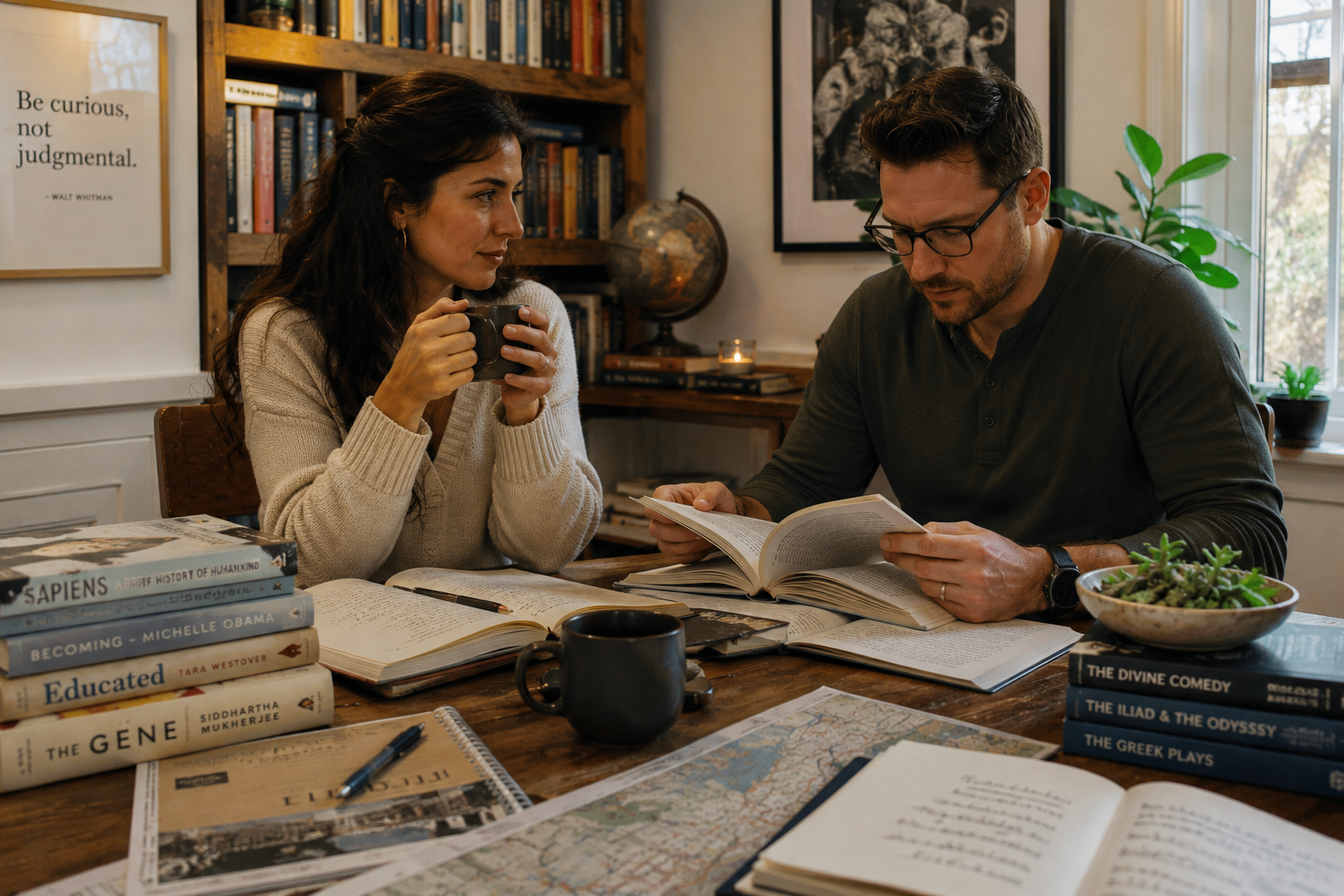
Key Takeaways
A learning-centered marriage must be built intentionally.
Without children organizing the household, a couple has unusual freedom to make curiosity, reading, travel, and meaningful conversation central to their shared life—but that opportunity must be deliberately protected.Intellectual connection should not replace emotional intimacy.
Shared learning can enrich a marriage, but constant debate and life lived only “in the mind” can weaken warmth, affection, and emotional safety. A healthy relationship needs both thoughtful conversation and non-intellectual connection.Different rest profiles can strengthen the relationship.
A spouse who rests differently may offer grounding, creativity, practical wisdom, or spiritual depth. The goal is not identical interests, but honest communication, outside learning communities, and appreciation for what each person brings.Shared curiosity helps a marriage keep growing.
Reading together, educational travel, cultural experiences, protected solitude, and thoughtful seasonal rituals create a shared intellectual history while allowing each partner’s individual interests to remain distinct.
You chose a person to share your life with, and somewhere in that choice — consciously or not — was the hope that you would not stop growing because of it. That the life you built together would be a life that kept learning, kept questioning, kept encountering the world with genuine curiosity. That the marriage would make you smarter and more alive, not less.
The educational rest profile in a marriage without children has an extraordinary opportunity to honor that hope. Without children to organize the household's time and energy, the lifelong learner in a childless marriage has something genuinely rare: a shared domestic life in which learning can be a genuine shared value rather than a privately-maintained personal habit squeezed into margins already crowded with family demands.
This article is about building that life deliberately — using each season, navigating the specific dynamics of learning alongside a spouse who may or may not share your intellectual appetite, and creating a marriage that is genuinely, sustainably nourishing to the curious mind.
The Benefits and Challenges of Educational Rest with Different Profiles
When You Share the Same Learning Orientation
Two lifelong learners in a marriage without children have access to one of the most sustaining domestic arrangements imaginable. The home is intellectually alive. Conversations are substantive. The book collection grows in interesting directions. Travel is chosen for its educational richness. The cultural calendar is full of lectures, museums, and events attended with genuine curiosity rather than social obligation.
Without children, these advantages exist in their most developed form. You have time to finish books. The dinner conversation can follow an interesting thread for an entire evening without interruption. The documentary series can be watched with genuine attention and discussed at length. The course you're both taking can actually be completed.
The risks in the same-profile intellectual marriage are the ones that intellectual intensity tends to produce: the marriage that lives entirely in the mind, that is rich in ideas and thinner on emotional intimacy, physical warmth, and the non-cognitive dimensions of shared life. Two people who love learning can also love being right, and the marriage that becomes a chronic debate society, however stimulating, can gradually erode the emotional safety that genuine intimacy requires.
The practice that helps most: consciously building emotional intimacy — conversations about feeling rather than thinking, physical affection maintained as a daily practice, time spent together in non-intellectual enjoyment — alongside the intellectual life.
When You Have Different Learning Profiles
The educational rest profile married to someone whose primary rest mode is physical, creative, or spiritual faces a specific kind of marital tension: the intellectual's need for substantive learning and discussion simply isn't matched by the primary relationship. This isn't a failure of the marriage. It is the predictable reality of two individuals, however well-matched, whose restoration comes from different sources.
Managing this well requires honesty about the gap, deliberate investment in intellectual friendships and communities outside the marriage, and genuine appreciation for what the differently-oriented spouse offers: often a quality of embodied presence, practical wisdom, or creative intuition that the primarily cognitive person genuinely lacks and needs.
The gift the intellectual receives from a non-intellectual spouse is one of the most underappreciated in marriage: being loved by someone who doesn't primarily value you for your mind. Who finds you fascinating, or attractive, or necessary — but not because of your arguments. This form of love teaches something about being human that intellectual love alone cannot.
Spring: New Learning and the Intellectual Spring Renewal
Spring's energy of new beginnings makes it the natural season for intellectual renewal in marriage — for beginning what has been deferred, clearing out what no longer serves, and establishing the learning practices that will sustain both partners through the year.
Define a shared annual learning theme. A concept broad enough to explore from multiple angles but specific enough to provide direction: the history of a country or region, the science of a phenomenon you've both been curious about, the philosophy of a particular tradition, the literature of a specific culture or period. Make this theme the organizing thread of your joint intellectual life across the year — the books chosen, the travel considered, the conversations that arise naturally. Having a shared intellectual frame enriches the marriage's daily conversation in ways that individual reading alone cannot.
Build a reading partnership with explicit structure. Not just both reading the same book — though that too — but a genuine reading partnership: each person reading whatever interests them, keeping track of what's been most significant, and sharing selectively and with genuine generosity across the weeks. The intellectual marriage that has this practice in place describes dinner conversations that are consistently more interesting, more surprising, and more revealing of who each person is than those in marriages without it.
Visit the learning environments of your city with intention. University public lecture series, library author talks, museum programming, science center events. Spring's new programming season is the time to identify and calendar the intellectual events you actually want to attend — before the social calendar fills with other obligations. The intellectual married couple without children has no legitimate structural reason not to attend a Wednesday evening lecture. Do it.
Clean out the information diet deliberately. Both of you. The podcasts that have become habit rather than pleasure, the news sources generating anxiety rather than understanding, the social media feeds that simulate intellectual engagement while producing its opposite. Spring is the season for this kind of intellectual housekeeping, and doing it together — agreeing on what you're both stepping back from, and why — makes it both easier and more sustained.
Summer: Learning in the World
Summer takes intellectual life outside and experiential — into the places, people, and direct encounters with the complexity of things that book-learning alone cannot reach.
Take a genuinely educational summer journey. The marriage without children has the extraordinary freedom to travel when, where, and for as long as genuinely interests you — without family-friendly destination constraints, activity park requirements, or the sheer logistical complexity of traveling with children. Use this freedom for the kind of travel that lifelong learners actually want: a week in Athens for the history and the philosophy, a road trip through a literary landscape, a tour of an architectural tradition, a research trip to somewhere you've been reading about for years. Travel undertaken with genuine intellectual intention is among the most restorative and bonding experiences available to a curious married couple.
Pursue an intensive learning experience together. A week-long workshop in a subject that fascinates both of you. A language immersion course. An archaeological dig. A professional development experience attended together. A summer school or residential program offered by a university. Without children's demands structuring summer, the intellectually-oriented married couple can undertake genuinely immersive learning experiences — ones that produce significant growth in a compressed time and create shared intellectual experiences that become part of the marriage's permanent reference library.
Read separately and share generously. Summer's pace allows for significant reading, and two people reading different books in the same household are building separate but enrichable intellectual worlds. The generosity is in the sharing: not comprehensive reports of everything read, but the specific passages, ideas, or moments that produced a genuine response — surprise, recognition, disagreement, delight. These sharings are among the most intimate intellectual acts available in marriage, because they reveal the live, present state of another person's curiosity.
Take a digital summer sabbath together. One week of reduced information consumption — limited news, no social media, minimal podcasts. Summer is the ideal season for this because the outdoor environment provides natural stimulation and the social pace is often slower. Two people doing this together makes it both easier and more meaningful. Notice what your minds do with the increased quiet.
Autumn: Depth, Disagreement, and the Serious Season
Autumn is the educational rest profile's natural season — the season in which intellectual life reaches its deepest and most nourishing expression.
Read serious books together. Choose three or four genuinely substantive books for the autumn — ones that will take real time, produce real discussion, and change something about how you think. Read them simultaneously, at your own pace, without racing. Discuss them over dinner, on walks, in the natural pauses of shared life. This practice, sustained faithfully across an autumn, produces a quality of shared intellectual development that is among the most sustaining things a marriage can contain.
Have the intellectual disagreements that have been avoided. Every marriage has intellectual territories where the partners genuinely diverge — not just in opinion, but in underlying values and ways of knowing. Autumn is the season to enter these territories with genuine curiosity: not to win, but to understand. What does your spouse actually think about this? Not the shorthand position you've heard, but the lived, nuanced, present view? These conversations, conducted with genuine curiosity and genuine care for the relationship, often reveal dimensions of a spouse that years of ordinary conversation have somehow missed.
Attend the serious cultural events of autumn together. Literary festivals, gallery openings, major museum exhibitions, theatre of ambition and seriousness. Make attendance at one genuinely significant cultural event per month a feature of your autumn. Go as participants, not consumers — with the intention of discussing what you encounter with real engagement afterward. The couple that builds a shared cultural life across an autumn develops a shared intellectual vocabulary and a shared history of aesthetic and intellectual encounter that is among the richest things a marriage can contain.
Protect your individual intellectual solitude. Autumn is the season for sustained solitary intellectual work — the long reading mornings, the thinking walks, the writing that requires uninterrupted interior quiet. In a marriage, this requires explicit mutual support. Being the spouse who creates space for the other's intellectual solitude — who takes themselves away from the house so their partner can have genuine silence, who holds the domestic demands so the other can sustain a sustained intellectual project — is one of the most loving things available in a marriage of two curious minds.
Winter: Slow Learning and the Examined Marriage
Winter is the season in which the examined life — which Socrates identified as the only life worth living — becomes genuinely possible. The external demands are thin. The interior lengthens. The quality of the shared life — what it contains, what it means, whether it is truly nourishing — becomes unavoidable.
Turn the intellectual curiosity on each other. Winter is the season to be genuinely curious about the person you've chosen — not the person you thought you knew, but the person they currently are. What are they thinking about? What have they changed their mind on this year? What question has been living at the back of their mind that they haven't shared? What do they understand now that they didn't when the year began? These questions, asked with genuine curiosity in the long winter evenings, consistently reveal dimensions of a spouse that years of ordinary married life have somehow not uncovered.
Build the winter intellectual ritual. A weekly practice that is specifically about learning together: a documentary series watched with genuine attention and discussed seriously afterward; a book read aloud to each other over the winter months; a practice of sharing the single most interesting thing encountered each week; a monthly "teach me something" evening where each person shares something they've been learning. The specific form matters less than the commitment and the genuine engagement.
Write together, or alongside each other. Winter is the season for writing — journals, letters, essays, the sustained reflection that only winter's interiority makes possible. Two people writing in the same quiet room — each in their own private reflection — is a form of intellectual intimacy that is uniquely available in the winter marriage. What each person learns about themselves through writing, shared selectively and honestly, enriches the marriage's mutual understanding in ways that conversation alone cannot.
Practice intellectual gratitude. Name specifically, to each other, what you have learned from the other this year. Not the general "I've learned so much from you" — the particular. The specific book recommendation that has changed something in my life. The perspective that challenged a settled assumption. The question asked that you're still turning over. The way their mind works that continues to surprise and instruct you. This practice of specific intellectual gratitude is one of winter's most sustaining marital gifts.
Building Your Learning Marriage
The marriage of two curious people, without children to reshape its organizing principles, has an opportunity that is genuinely finite and genuinely precious: to build a shared intellectual life that is worthy of both people's capacity for curiosity, wonder, and genuine understanding.
This doesn't happen by accident. It requires the same intentionality as any other aspect of a marriage — explicit conversation, deliberate scheduling, mutual protection of each other's learning time, and the specific generosity of sharing what you're learning without requiring your spouse to be interested in exactly the same things.
Build it. Protect it. Let it deepen across the seasons.
A marriage that keeps learning is a marriage that keeps growing. And a marriage that keeps growing is one of the finest things available to human life.
