Rest Through the Body: Physical Recovery in a Marriage Without Children
A Rest Profile for the Physically Active Soul — Married, No Children
Key Takeaways
Physical wellbeing can become a shared marital value.
A marriage without children offers unusual freedom to organize sleep, movement, nutrition, recovery, and the home environment around both partners’ physical health.Recovery deserves equal value with performance.
When both partners are physically active, comparison and competition can quietly replace care. A healthier rhythm celebrates rest days, honors different recovery needs, and treats injury or fatigue as invitations for support.Different physical needs require honest communication.
One spouse may need structured movement, early sleep, or intentional recovery while the other relates to the body more casually. Naming those needs clearly prevents resentment and allows each partner to strengthen the other.Shared physical rhythms create long-term resilience.
Walking, sleeping well, cooking nourishing meals, supporting solo practices, co-regulating through safe physical presence, and allowing purposeless rest build a foundation that can sustain the marriage through future seasons.
Your body is your primary instrument of understanding the world and your primary site of restoration. You know this in a way that is deeper than intellectual — you feel it in the difference between a week when you've moved well and slept well and the one where you haven't. You feel it in the way physical rest genuinely restores you, and in the way that its absence accumulates into a kind of heaviness that nothing else quite resolves.
Being married and without children gives the physical rest profile something genuinely rare: a life in which physical wellbeing can be organized and prioritized as a genuine shared value, without the particular sacrifices — disrupted sleep, sidelined training, nutritional chaos — that parenthood reliably produces. You and your spouse can, if you choose to build it consciously, live a genuinely physically healthy and restorative shared life in a way that will become dramatically more complicated if children arrive, and that many couples look back on with wistfulness when they do.
This is not about being grateful that you don't have children. It is about using the physical freedom and energy of this particular life stage — with intention, with care, and with the honest recognition that it is a genuine gift — to build physical health habits and physical rest practices that serve both of you well.
The Benefits and Challenges of Physical Rest with Different Profiles
When You Share the Same Physical Orientation
Two physically-oriented partners in a marriage without children have the potential for one of the most genuinely healthy shared lives available. You can structure your household around physical wellbeing — the food you buy, the schedules you keep, the activities you prioritize — without negotiating against someone else's fundamentally different relationship to the body. You can train together, recover together, sleep according to mutually compatible rhythms, and build a shared life in which physical health is not a personal hobby but a shared value.
The risks arrive around performance and comparison, particularly in marriages where both people have active training lives. Partners can inadvertently create a competitive dynamic — each using the other's fitness as an internal measure, each subtly pressuring the other toward intensity rather than recovery. Injury in one partner can become a source of tension rather than an opportunity for mutual care. The partner who needs more recovery can feel judged by the one who is still training hard.
The practices that help: explicitly distinguishing and equally valuing training and recovery; celebrating each other's rest days with the same enthusiasm as each other's performance days; and treating physical vulnerability — injury, illness, the body's need for genuine ease — as an opportunity for care rather than a problem to be overcome.
When You Have Different Physical Profiles
The physically-oriented person married to someone whose rest profile is primarily intellectual, creative, or spiritual faces a specific and common challenge: their need for structured physical activity, quality sleep, and intentional recovery is simply not shared by their spouse — who may find the physical self-consciousness somewhat exhausting, the recovery protocols overly rigid, and the early bedtimes socially limiting.
The benefits of navigating this difference well are genuine. The physical person pulls the more sedentary spouse toward movement, outdoor time, and a level of physical self-care that improves their health and wellbeing in measurable ways. The non-physical spouse often models a more fluid relationship to the body — less performance, more pleasure — that can genuinely benefit the physically intense partner.
What's required is honest communication, without apology or minimization, about what physical needs actually are. The physically-oriented person in a marriage with a differently-oriented spouse often downplays their needs to avoid seeming high-maintenance. This is a mistake. Unmet physical needs don't disappear. They accumulate into resentment, depleted energy, and the specific slow burn of a body that is being systematically denied what it requires.
Spring: Waking the Shared Body and Building Physical Rhythms Together
Spring is the body's natural invitation to reawaken — and in a marriage without the structural impositions of parenthood, it is an opportunity to design your physical life together with genuine intentionality.
Establish a shared daily movement practice. A morning walk before the day begins. An evening run together. A yoga practice at the same time each day, whether in the same space or in different rooms. The shared physical ritual — something both people do consistently, together or in parallel — builds a physical intimacy and a household rhythm that is one of the most stabilizing elements of a healthy marriage. Spring is the natural season to begin it.
Design your physical home environment together. Without children's safety constraints and toy management demands, the married couple without kids can organize their physical home in genuine service of wellbeing. A bedroom optimized for sleep — cool, dark, quiet, with technology kept out. A kitchen stocked and arranged in support of the food choices that serve both of you. A space for physical practice — a yoga mat, a pull-up bar, a stretching area — integrated naturally into the domestic environment. These are not vanity projects. They are infrastructure.
Build a spring physical goals conversation. Not as a performance accountability system, but as a genuine shared visioning: what do we each want to feel like physically this year? What do we want to be able to do? What recovery practices have we been neglecting? What does physical health look like in our marriage right now, and what would we change? This conversation — held in spring, when the energy for change is highest — sets a physical intention for the year.
Find your overlapping physical pleasures. Not the activity one drags the other to — the genuine, mutual physical pleasure that both of you actually enjoy and find restorative. Hiking, cycling, tennis, dancing, swimming, recreational sport, long walks. These shared physical pleasures are worth significant investment because they simultaneously provide physical restoration, sensory pleasure, and relational connection. Without children, you have the time and flexibility to find and develop them properly.
Summer: Embodied Joy and the Physical Season of Abundance
Summer is the physically-oriented person's natural season — warmth, light, outdoor movement, water, and the cultural permission to prioritize the body's pleasure. In a marriage without children, summer's physical abundance is essentially unconstrained by external demands.
Take a genuinely physically restorative summer trip. Not a trip packed with activities and sightseeing — a genuinely restorative one. A hiking week in a national park. A cycling trip through the countryside you've wanted to see. A beach week with no agenda other than water, sun, and early bedtimes. A yoga retreat for both of you. The marriage without children can afford to take a trip that is genuinely about physical restoration rather than family entertainment — and these trips produce a quality of physical recovery that no ordinary weekend can replicate.
Create a summer physical ritual together. A daily swim. An evening walk that has become non-negotiable. A Saturday morning of outdoor activity followed by a long, slow breakfast. The specific activity matters less than the consistency and the shared commitment. Physical rituals in a marriage function as anchors — they mark time, establish shared rhythm, and create the kind of reliable, repeated pleasure that sustains wellbeing across the most demanding seasons of life.
Support each other's solo physical practices actively. The spouse who trains seriously needs more than their partner's tolerance for the training schedule — they need active support. "I'll manage the morning — go run" is one of the most physically loving things a spouse can say. The marriage that builds genuine mutual support for individual physical practices is building individual health on a foundation of relational care.
Rest from physical performance explicitly. Summer's energy can pull the physically-oriented person toward continuous activity — more training, more sport, more physical achievement. The body needs permission to simply enjoy physical existence without measuring it. An afternoon lying by water without a training goal. A weekend of gentle movement chosen entirely for pleasure. A meal eaten slowly and entirely for sensory pleasure, without tracking its nutritional content. These experiences of physical ease are themselves a form of rest, and the spouse who invites them is offering genuine physical care.
Autumn: Recovery, Physical Honesty, and the Season of Slowing Down
Autumn asks the body to slow down and consolidate — to move from the expansive physical activity of summer toward the deeper, more careful physical self-care that prepares the body for winter.
Commit to a genuine autumn recovery program. If summer involved training, travel, and sustained physical output, autumn is the season to reduce intensity deliberately, increase sleep duration, prioritize nutrition, and address the accumulated physical costs of the busy season. In a marriage without children, doing this together — both people explicitly choosing a lower-intensity physical season — normalizes recovery as a legitimate and planned phase rather than a failure of motivation.
Invest in professional physical care together. Massage, sports therapy, acupuncture, chiropractic — whatever forms of bodywork serve each of you. Autumn is the ideal season to establish these as regular practices rather than emergency responses to injury or crisis. The couple that builds professional physical care into the regular structure of their shared life is investing in health in one of the most evidence-backed ways available. Without children's expenses and demands, this investment is more financially feasible in this season of life.
Eat for the season with genuine care. Autumn's harvest is extraordinarily nutritious — root vegetables, dark leafy greens, legumes, warming spices, seasonal proteins. Cooking for two people, with genuine attention to nutritional quality and seasonal eating, is both physically nourishing and one of the great pleasures of domestic married life. Without children's food preferences and mealtime management to navigate, the physically-oriented married couple can cook exactly what serves their bodies, with exactly the care the body deserves.
Have an honest physical conversation. Autumn is the season for checking in honestly about the physical state of the marriage: How is each person sleeping? What physical patterns have developed that aren't serving either of you? Where has physical self-care contracted, and why? These conversations — held without criticism, with genuine mutual concern — are the preventive maintenance of physical wellbeing in marriage.
Winter: Deep Physical Rest and Being Held
Winter asks the body to do what it naturally does in alignment with the natural world: slow down, restore, sleep more, eat more warmly, and find the particular contentment of physical ease in a warm interior space. In a marriage, winter is also the season of the most intimate physical rest: co-regulation, the daily reality of two nervous systems in close proximity shaping each other toward greater ease.
Take sleep seriously as a joint priority. Winter's longer nights and earlier darkness create the natural conditions for more sleep — and the marriage without children can actually claim them, without a child's nightmare or early morning needs interrupting. Go to bed earlier. Sleep as long as the body asks. Invest in the sleep environment: the right temperature, the darkness, the quiet. The couple that prioritizes sleep as a shared value — that actively protects each other's sleep rather than competing with it — is doing one of the most physically generous things available in marriage.
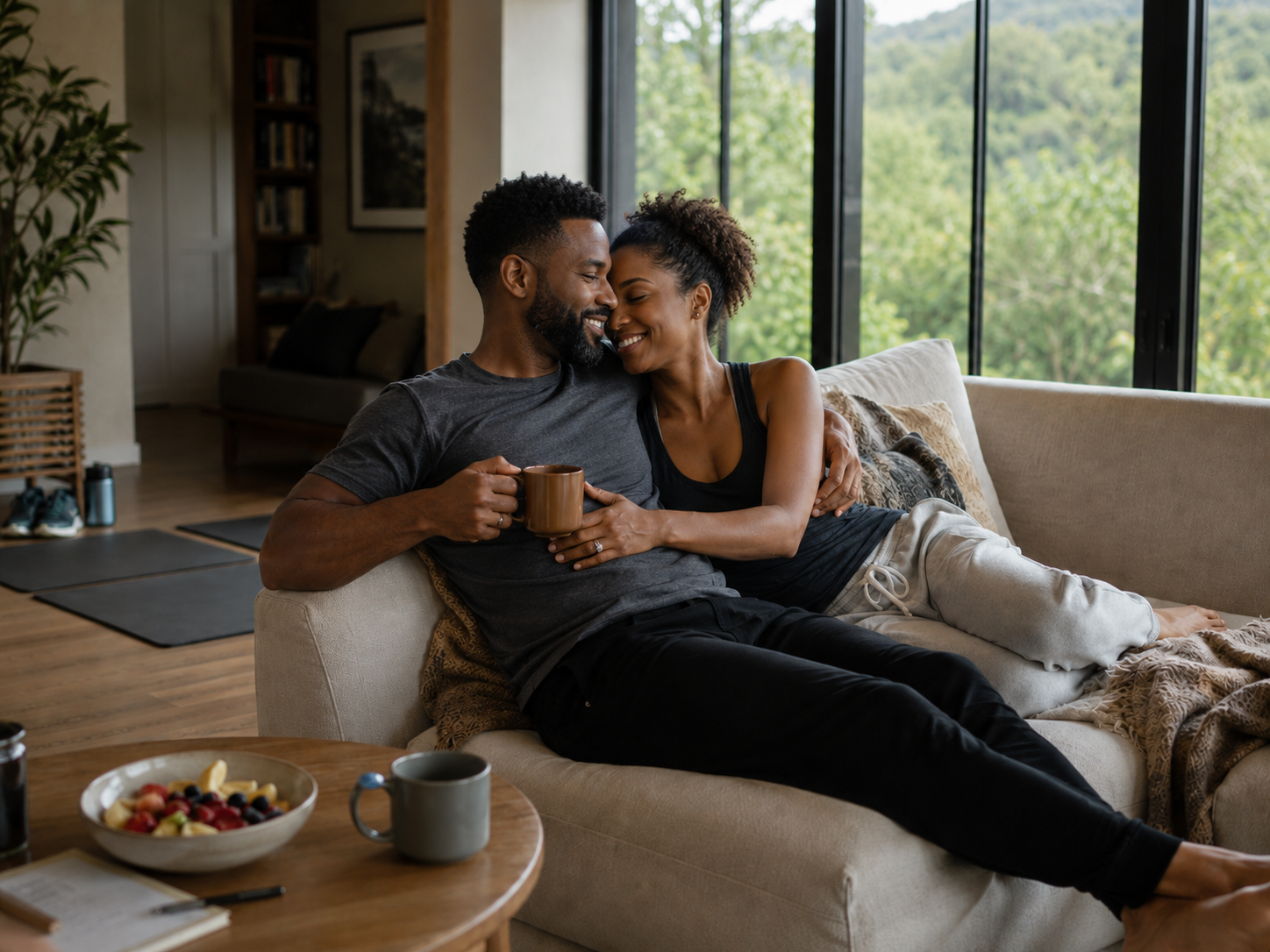
Practice deliberate co-regulation. The research on co-regulation — the way two nervous systems in close physical proximity influence each other — suggests that the quality of physical rest available in a loving, safe marriage is genuinely different from what can be achieved alone. Extended physical contact — slow, nonsexual, unhurried — directly influences cortisol levels, heart rate variability, and immune function. The twenty-second hug. The hand resting on the shoulder. Sitting in genuine proximity without the mediation of screens or activities. In winter especially, these forms of physical contact are restorative medicine.
Create a winter body-care ritual together. A shared practice that marks the transition from activity to rest — whether a weekly sauna, a nightly stretching routine done together, an evening walk taken in the winter cold, a bath drawn with genuine care and occasion. The specific ritual matters less than the commitment to it and the quality of presence brought to it. Physical rituals in marriage create the anchors that make even the hardest weeks survivable.
Give each other genuine rest without agenda. The highest physical gift one spouse can give another in winter is unstructured, purposeless physical ease: the permission to lie on the couch all afternoon, to sleep past what feels reasonable, to do nothing physical with no goal and no guilt. For the physically-oriented person, this is harder than it sounds — the internal pressure to move, to train, to maintain the practice is strong. The spouse who offers genuine permission for physical laziness, and models it alongside their partner, is offering real care.
Building Your Physical Marriage
The physically-oriented person in a marriage without children has a window — genuinely finite, genuinely precious — in which to build the physical health practices, habits, and shared rhythms that will sustain both partners for the long term.
Build them now. Sleep well together now. Move well together now. Rest together with genuine, unpressured ease now. The infrastructure of physical wellbeing that you build in this season of your marriage will serve you through every season that follows — including the ones in which it becomes significantly harder to build it from scratch.
Your body is your home. Your marriage is where you live in that home together.
Tend both with the care they deserve.
